2026-03-14 • 6 min
Fast Reply Challenge: How It Works and Why Short, Limited Sessions Win
A detailed breakdown of Reply(x) Fast Reply Challenge, why limiting actions in short time blocks protects account safety, and how to build a healthier daily rhythm on X.
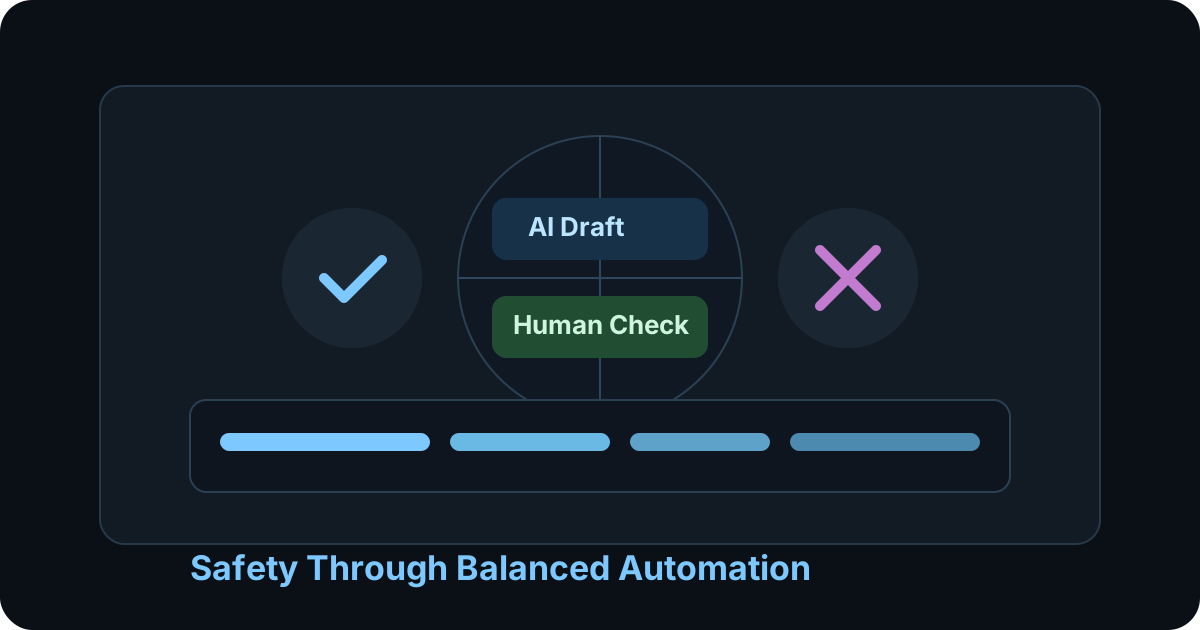
Key takeaways
- Fast Reply Challenge in Reply(x) is designed as a focused sprint, not an endless activity loop. In the current flow, you process a fixed set of 10 posts in a 5-minute session with a visible timer, then mark each post as done or ignore while moving through suggestions quickly.
- The value of this format is operational control. Instead of drifting into unstructured browsing and over-engagement, you work in a time box with a clear finish line. That improves decision quality and helps you avoid spending too long on platform behaviors that do not compound.
- A key principle behind this challenge is simple: shorter sessions with fewer actions are usually safer than long, high-volume bursts. Practical guidance is to keep total actions limited in a session and avoid pushing beyond roughly 30 interactions in one intense block. Frequent, smaller windows distributed through the day are a better pattern.
Why this matters
Fast Reply Challenge in Reply(x) is designed as a focused sprint, not an endless activity loop. In the current flow, you process a fixed set of 10 posts in a 5-minute session with a visible timer, then mark each post as done or ignore while moving through suggestions quickly.
The value of this format is operational control. Instead of drifting into unstructured browsing and over-engagement, you work in a time box with a clear finish line. That improves decision quality and helps you avoid spending too long on platform behaviors that do not compound.
Execution playbook
A key principle behind this challenge is simple: shorter sessions with fewer actions are usually safer than long, high-volume bursts. Practical guidance is to keep total actions limited in a session and avoid pushing beyond roughly 30 interactions in one intense block. Frequent, smaller windows distributed through the day are a better pattern.
This “often but less” approach reduces risk from unnatural spikes and protects your cognitive quality. When people overextend in one sitting, replies become generic, tone drifts, and error rate grows. Short sessions keep your replies precise and your account behavior more natural.
The timer inside Fast Reply Challenge is not only a gamification element. It acts as a guardrail. You can clearly see how long you are spending, whether you are slowing down too much on low-value threads, and when it is time to stop instead of forcing extra actions.
Another benefit is decision clarity. The challenge narrows each step to concrete choices: process the current post, use or copy a relevant response, then move to done or ignore. This reduces context switching and prevents the “open 20 tabs and do nothing” pattern that wastes attention.
If your goal is account longevity, use challenge sessions as part of a daily rhythm. Example structure: one short morning sprint, one mid-day sprint, one late-afternoon sprint. Keep each session tight, maintain reply quality, and stop when the session ends even if you feel momentum to continue.
In practice, the challenge also supports healthier usage behavior. Because time is visible and bounded, you are less likely to stay online longer than planned. That matters for creators and founders who need output quality on X without sacrificing deep work for product, clients, or content systems.
What to apply this week
To run this safely, keep three rules: prioritize relevance over speed, avoid exceeding your action limit in a single burst, and spread your sessions throughout the day. These rules preserve quality, reduce platform risk, and make growth more sustainable than aggressive one-shot activity.
Fast Reply Challenge works best when treated as a disciplined execution mode. You are not trying to “win” by maximum clicks. You are building a repeatable habit: focused sessions, controlled volume, cleaner decisions, and better long-term account outcomes.